
How Does a Road Sweeper Improve Industrial Cleaning Efficiency?
Release time: 2026-06-26
Industrial facilities, warehouses, and commercial properties face increasing pressure to maintain clean and safe outdoor environments. Traditional manual sweeping methods may work for small areas, but they become inefficient when managing large yards, parking lots, industrial parks, and logistics centers.
A modern road sweeper provides a more efficient solution by combining mechanical sweeping, debris collection, and dust control technologies. Instead of relying on extensive manual labor, businesses can improve cleaning productivity, reduce operating costs, and maintain a safer working environment.
For facility managers, the question is no longer whether an area can be cleaned, but how efficiently and sustainably it can be maintained.
Why Are Traditional Industrial Cleaning Methods Becoming Inefficient?
For many years, manual sweeping has been widely used for outdoor maintenance. However, as industrial spaces become larger and environmental requirements become stricter, traditional cleaning approaches are showing clear limitations.
High Labor Requirements
Large outdoor areas require significant manpower when cleaned manually.
Workers need to:
- Sweep dust and debris repeatedly
- Collect waste manually
- Cover large areas on foot
- Repeat cleaning cycles frequently
This process consumes valuable working hours and creates inconsistent cleaning results.
For factories, warehouses, and logistics facilities operating daily, labor efficiency has become a major factor affecting overall maintenance costs.
Limited Cleaning Coverage
Manual sweeping is difficult to scale.
A worker can only clean a limited area within a specific time period, making it challenging to maintain:
- Factory yards
- Parking areas
- Construction sites
- Industrial roads
- Large commercial spaces
A professional industrial road sweeper allows businesses to cover larger areas faster while maintaining consistent cleaning performance.
Poor Dust Control
Outdoor industrial environments often contain fine particles from:
- Vehicle movement
- Manufacturing activities
- Material transportation
- Weather conditions
Traditional sweeping can create secondary dust pollution by disturbing particles on the ground.
Modern sweeping equipment uses integrated dust control systems to capture debris while reducing airborne particles, improving workplace safety and environmental conditions.
How Does a Road Sweeper Work?
A road sweeper is not simply a mechanical broom. Modern machines integrate multiple technologies to improve cleaning efficiency.
The main cleaning process includes three key stages:
1. Mechanical Sweeping System
Rotating brushes loosen dirt, dust, and debris from the surface.
Depending on the application, sweepers can handle:
- Sand
- Leaves
- Small waste materials
- Industrial dust
- Road debris
The mechanical sweeping action provides stronger and more consistent results compared with manual tools.
2. Debris Collection and Storage
After debris is removed from the surface, the collection system transfers waste into a storage hopper.
This reduces the need for workers to manually gather waste and improves overall cleaning speed.
For large industrial environments, efficient debris collection is essential because cleaning tasks often involve extensive areas and frequent operation.
3. Dust Suppression Technology
One of the biggest advantages of modern commercial road sweeping machines is their ability to control dust.
Through water spraying systems and enclosed collection designs, these machines help:
- Reduce airborne particles
- Improve operator visibility
- Protect nearby equipment
- Maintain cleaner surroundings
This is especially important for industrial facilities where dust can affect machinery performance and workplace safety.
What Benefits Does an Industrial Road Sweeper Provide?
Businesses invest in professional sweeping equipment because it improves productivity while reducing long-term operational challenges.
1. Higher Cleaning Productivity
The primary advantage of a road sweeper is its ability to clean large areas in less time.
Compared with manual sweeping:
| Cleaning Method | Coverage Efficiency | Labor Requirement | Cleaning Consistency |
|---|---|---|---|
| Manual Sweeping | Low | High | Depends on operator |
| Small Cleaning Tools | Medium | Medium | Variable |
| Industrial Road Sweeper | High | Low | Stable |
For businesses managing large outdoor spaces, productivity improvements directly translate into reduced maintenance costs.
2. Lower Labor Costs
Labor is often one of the largest expenses in facility maintenance.
A ride-on sweeping machine allows operators to complete large-scale cleaning tasks with less physical effort.
Benefits include:
- Reduced repetitive labor
- Faster cleaning cycles
- Better workforce allocation
- Improved daily maintenance efficiency
Instead of spending hours on basic sweeping tasks, employees can focus on other important facility operations.
3. Improved Workplace Safety
Clean industrial environments are not only about appearance.
Accumulated dust and debris can create:
- Slip hazards
- Equipment problems
- Poor visibility
- Unsafe working conditions
Regular sweeping with professional equipment helps maintain cleaner and safer workplaces.
This is especially valuable for:
- Manufacturing plants
- Warehouses
- Logistics centers
- Commercial properties
Why Are Enclosed Road Sweepers Becoming More Popular?
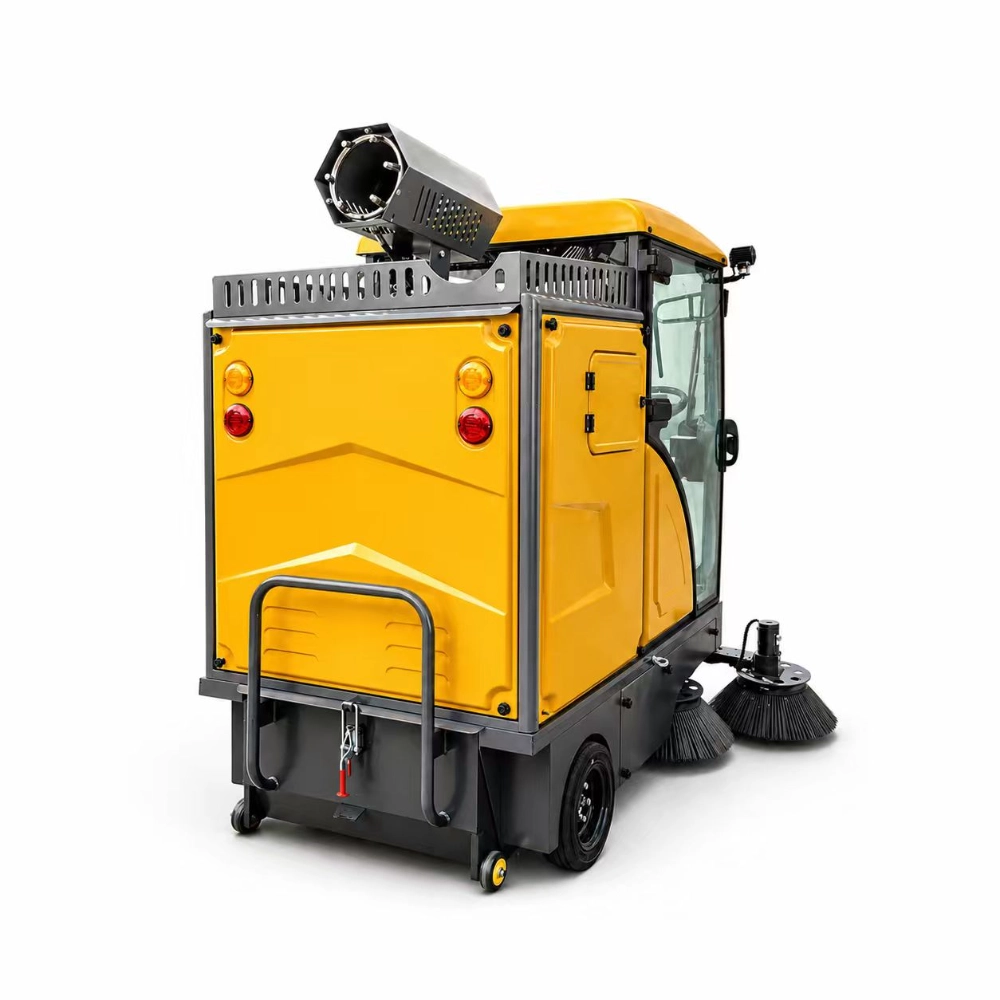
In recent years, enclosed road sweepers have gained attention because they improve both operational efficiency and operator comfort.
Compared with open-style sweepers, enclosed models provide advantages such as:
| Feature | Open Sweeper | Enclosed Road Sweeper |
|---|---|---|
| Operator Protection | Limited | Better |
| Weather Resistance | Lower | Higher |
| Dust Exposure | Higher | Reduced |
| Long Working Comfort | Limited | Improved |
An enclosed cabin helps protect operators from:
- Dust
- Wind
- Rain
- Outdoor temperature changes
This makes them suitable for longer working periods and demanding industrial environments.
How to Select the Right Industrial Road Sweeper?
Choosing the correct sweeping machine requires evaluating the actual working environment.
Key factors include:
| Selection Factor | Why It Matters |
|---|---|
| Cleaning Area Size | Determines required productivity |
| Surface Type | Affects brush performance |
| Debris Type | Influences cleaning capability |
| Working Hours | Determines endurance requirements |
| Storage Space | Impacts equipment management |
Businesses should consider:
- Daily cleaning frequency
- Outdoor area size
- Waste materials commonly collected
- Operator requirements
- Maintenance expectations
Selecting equipment based on real operational needs helps maximize long-term value.
Why Choose ZoyonCleaner Road Sweeping Solutions?
As industrial cleaning requirements continue to evolve, businesses need equipment that provides reliable performance, efficient operation, and long-term durability.
ZoyonCleaner focuses on developing professional cleaning solutions for commercial and industrial applications. The ZY-X2 Enclosed Road Sweeper combines efficient sweeping performance, enclosed operator protection, and practical design features to support demanding outdoor cleaning tasks.
Designed for applications such as factories, warehouses, industrial parks, and large commercial areas, ZY-X2 helps businesses improve cleaning productivity while reducing dependence on manual labor.
With manufacturing expertise and a focus on real-world cleaning challenges, ZoyonCleaner provides dependable sweeping solutions for global customers seeking more efficient facility maintenance.
For companies looking for a reliable industrial sweeping machine, ZoyonCleaner delivers professional equipment designed to meet modern cleaning demands.
Frequently Asked Questions (FAQ)
What is a road sweeper used for?
A road sweeper is designed to remove dust, debris, leaves, and waste from outdoor surfaces such as roads, factory yards, parking lots, and industrial areas.
How does a road sweeper improve cleaning efficiency?
A road sweeper improves efficiency by combining mechanical brushing, debris collection, and dust control systems, allowing operators to clean larger areas faster than manual methods.
Are industrial road sweepers suitable for factories?
Yes. Industrial road sweepers are commonly used in factories, warehouses, logistics centers, and industrial parks where large outdoor areas require regular maintenance.
What is the difference between a road sweeper and manual sweeping?
Manual sweeping relies on human labor and is limited by working speed and coverage area. A road sweeper uses automated systems to provide faster, more consistent cleaning performance.
Why choose an enclosed road sweeper?
An enclosed road sweeper provides better operator protection from dust, weather conditions, and outdoor working environments, making it suitable for longer cleaning operations.