
How Does an Industrial Sweeper Reduce Labor Costs?
Release time: 2026-08-06
Table of Contents
Factories, warehouses, logistics centers, and industrial parks often have large outdoor or semi-outdoor areas that need regular sweeping. The challenge is not simply removing dust and debris; it is doing so without consuming excessive labor hours or interrupting daily operations.
As cleaning areas grow, manual sweeping becomes increasingly difficult to scale. An industrial sweeper can shift this work from labor-intensive cleaning to a more structured, mechanized process, allowing one operator to cover larger areas with more consistent results.
For facility managers, the real value lies in more than cleaning speed. It is the ability to control labor input while maintaining a predictable cleaning schedule.

Why Does Manual Sweeping Become Expensive in Large Facilities?
Manual sweeping may appear inexpensive because the equipment itself costs very little. However, the labor required to operate it repeatedly can become a significant operating expense.
A large facility may need workers to:
- Sweep extensive floor areas
- Collect accumulated debris
- Revisit high-traffic zones
- Clean around production and storage areas
- Repeat the process throughout the week
The larger the site, the more difficult it becomes to maintain consistent cleaning with the same workforce.
This is where mechanized sweeping changes the cost structure.
Instead of calculating cleaning requirements by the number of workers needed, a facility can evaluate how much area an operator and a machine can maintain within a defined working period.
How Does an Industrial Sweeper Reduce Labor Input?
An industrial sweeper reduces labor requirements primarily by replacing repetitive manual movement with mechanical sweeping and debris collection.
The operator remains responsible for controlling the machine, monitoring the environment, and managing the cleaning route. However, the physical process of repeatedly pushing a broom and manually gathering debris is largely mechanized.
A typical sweeping cycle can combine:
- Mechanical brush agitation
- Debris collection
- Dust management
- Waste storage
This matters because labor productivity is not determined only by how quickly someone can sweep. It also depends on how much non-cleaning time is spent moving equipment, collecting waste, repeating passes, and covering large distances.
What Makes Mechanized Sweeping More Productive?
A professional industrial sweeping machine improves productivity through several technical factors.
Mechanical Brush Systems
Rotating brushes continuously move dust and debris toward the collection system.
This provides more consistent mechanical action than a handheld broom and reduces the physical workload placed on operators.
Integrated Debris Collection
Instead of sweeping waste into piles and collecting it separately, a machine can transfer debris into an integrated hopper or collection container.
That eliminates several manual steps from the cleaning workflow.
Wider Cleaning Coverage
Ride-on sweepers are particularly useful when a facility has large floor areas, outdoor yards, parking areas, or logistics zones.
ZoyonCleaner’s current Sweeping Machines range includes ride-on models designed for factories, warehouses, workshops, industrial parks, roads, parking lots, logistics centers, and public facilities.
How Much Can an Industrial Sweeper Improve Cleaning Productivity?
The exact labor savings depend on the facility layout, debris type, cleaning frequency, machine configuration, and operator experience. Therefore, businesses should avoid using a single percentage as a universal benchmark.
A more useful comparison is to examine the structure of the cleaning task.
| Factor | Manual Sweeping | Industrial Sweeper |
|---|---|---|
| Physical sweeping | Operator-intensive | Mechanized |
| Debris collection | Often separate | Integrated |
| Large-area coverage | Labor-intensive | More efficient |
| Operator workload | High | Lower |
| Cleaning consistency | Operator-dependent | More standardized |
| Workforce scalability | Limited | Better |
| Cleaning schedule | Difficult to standardize | Easier to plan |
The objective is not necessarily to eliminate cleaning personnel. Rather, the goal is to allow each employee to accomplish more useful work within the same shift.
Why Should Businesses Measure Total Cleaning Cost?
A common mistake when purchasing cleaning equipment is to compare only the machine purchase price with the price of manual labor.
A more accurate evaluation should include:
Total Cleaning Cost = Labor + Consumables + Maintenance + Energy + Downtime
For example, a low-cost cleaning method may require more workers and more working hours. A mechanized solution may have a higher initial investment but reduce recurring labor requirements.
This is why total cost of ownership (TCO) is more meaningful than purchase price alone.
Facility managers should compare:
- Annual labor hours
- Cleaning frequency
- Area requiring maintenance
- Machine utilization
- Maintenance requirements
- Energy consumption
- Expected service life
This approach provides a more realistic picture of return on investment.
Which Facilities Benefit Most from Industrial Sweepers?
Not every cleaning environment requires an industrial machine.
The strongest business case typically appears where three conditions exist:
Large area + frequent cleaning + high labor input
Typical applications include:
Factories
Production facilities can accumulate dust, packaging waste, and material debris around workshops and yards.
Warehouses
Forklift traffic and material handling can generate dust and debris across large floor areas.
Logistics Centers
Continuous vehicle and cargo movement creates frequent cleaning requirements.
Parking Lots
Large outdoor surfaces are difficult to maintain efficiently using manual tools.
Industrial Parks
Long roads, shared areas, and outdoor facilities require regular sweeping over extensive distances.
These are precisely the types of environments where mechanized cleaning can deliver measurable productivity improvements.
How Does Dust Control Affect Labor Efficiency?
Dust management is often overlooked when discussing cleaning costs.
When sweeping generates secondary dust, operators may need to repeat cleaning or spend additional time addressing surrounding areas.
Modern sweeping equipment can incorporate dust collection or suppression mechanisms to help control airborne particles.
This has two potential benefits:
- Less secondary contamination
- More controlled cleaning operations
ZoyonCleaner’s sweeping product range includes machines designed around dust and debris collection for commercial and industrial cleaning environments.
Industrial Sweeper vs Manual Labor: What Should Buyers Measure?
Rather than asking only “How much does the machine cost?”, facility managers should ask:
- How many labor hours are currently spent sweeping?
- How frequently does the area need cleaning?
- How large is the cleaning zone?
- How much time is spent collecting debris?
- Can one operator manage the required area?
- What happens when cleaning is delayed?
A simple internal assessment can look like this:
| KPI | Before Mechanization | After Mechanization |
|---|---|---|
| Cleaning labor hours | High | Potentially lower |
| Manual sweeping tasks | Many | Reduced |
| Area covered per shift | Limited | Higher potential |
| Waste collection steps | Multiple | Streamlined |
| Cleaning consistency | Variable | More standardized |
The actual results should always be validated through site-specific trials rather than assumed from machine specifications alone.
Why Choose ZoyonCleaner for Industrial Sweeping Equipment?
For businesses looking to reduce the labor burden associated with large-area cleaning, equipment selection should be based on real operating conditions rather than specifications alone.
ZoyonCleaner focuses on industrial cleaning equipment and provides a product portfolio covering floor scrubbers, ride-on sweepers, and other professional cleaning solutions. The company states that its cleaning equipment is developed for global industrial scenarios, with an emphasis on adaptable solutions and manufacturing capability.
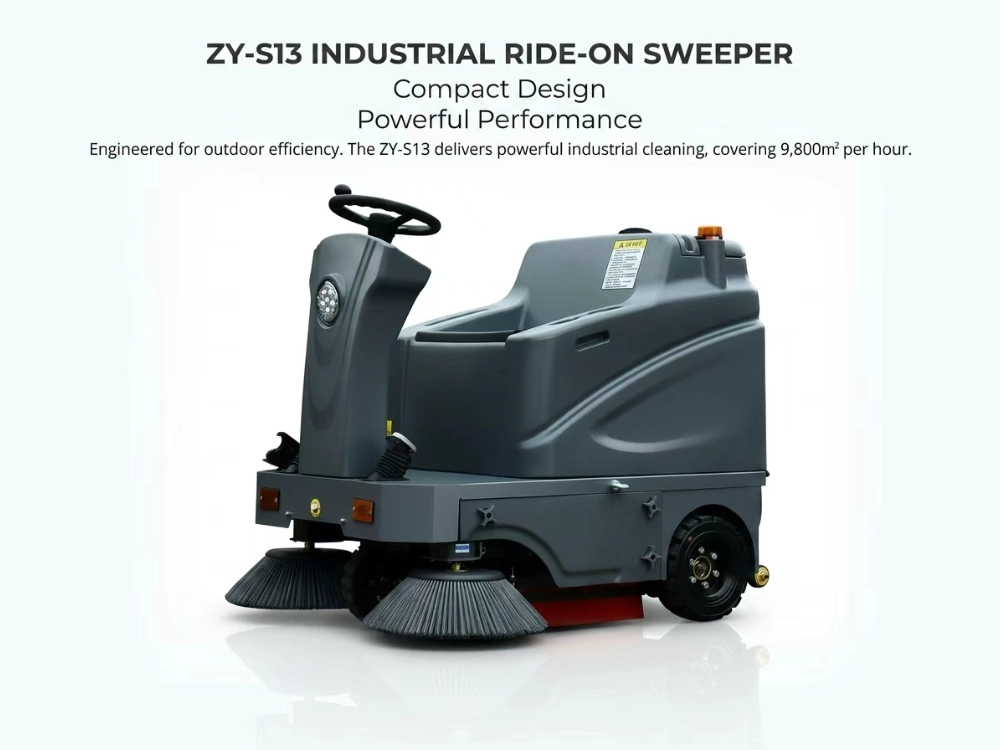
Its ride-on sweeping range includes models designed for industrial and commercial applications, giving facility managers options for different cleaning requirements. Current product listings include the ZY-X2, ZY-X3, ZY-X7, ZY-S13, ZY-S15, and other ride-on sweeping machines.
For companies seeking to reduce repetitive sweeping labor while improving daily cleaning productivity, ZoyonCleaner can provide professional industrial sweeping equipment matched to different facility requirements.
Frequently Asked Questions
How does an industrial sweeper reduce labor costs?
An industrial sweeper mechanizes repetitive sweeping and debris collection, allowing operators to cover larger areas with less physical labor and fewer manual cleaning steps.
Is an industrial sweeper suitable for warehouses?
Yes. Industrial sweepers are commonly used in warehouses and logistics facilities where large floor areas, vehicle traffic, and accumulated dust require regular maintenance.
Does an industrial sweeper replace cleaning workers?
Not necessarily. The main purpose is to improve worker productivity. Operators still control the equipment, monitor cleaning conditions, and perform maintenance and related tasks.
How should I calculate the ROI of an industrial sweeper?
Compare the machine’s total ownership cost with the current annual cleaning cost, including labor hours, consumables, maintenance, energy, and downtime. Site-specific operating data provides the most reliable ROI estimate.
What is the difference between an industrial sweeper and a floor scrubber?
An industrial sweeper primarily removes dry dust and debris through mechanical sweeping and collection. A floor scrubber uses water, cleaning solution, brushes, and a recovery system to wash hard floors.
What areas are suitable for ride-on sweepers?
Ride-on sweepers are particularly useful for large facilities such as factories, warehouses, logistics centers, parking lots, industrial parks, and other commercial or outdoor areas.