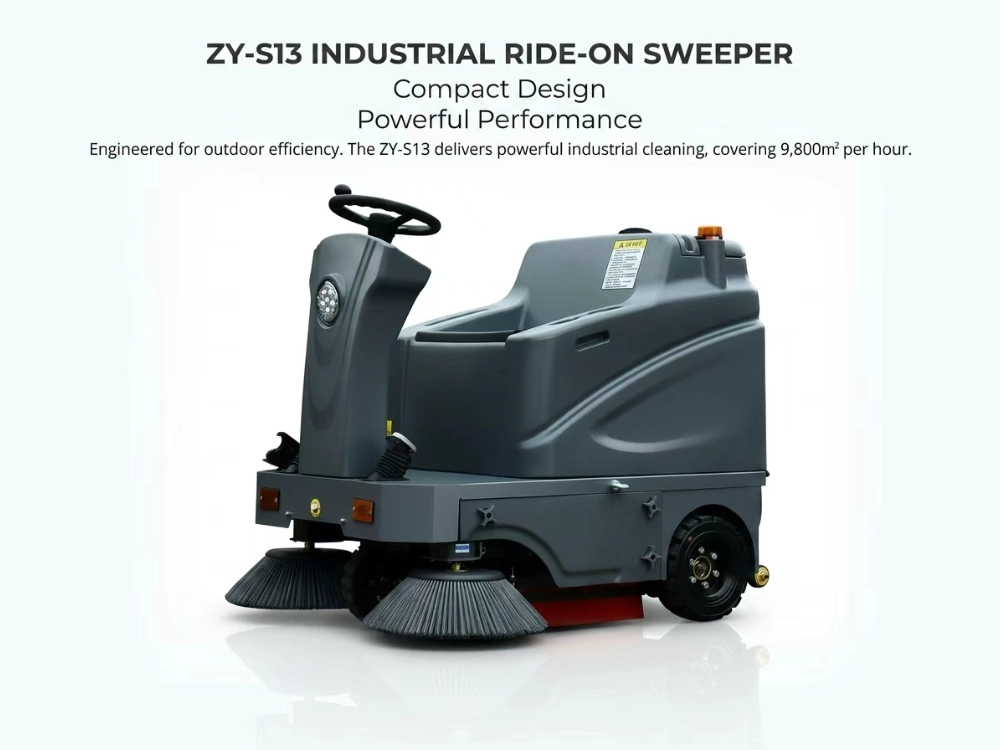

What to Look for When Buying a Commercial Industrial Sweeper: Complete Buying Guide 2026
Release time: 2026-05-08
Heavy industrial dust is a silent killer of warehouse machinery. Manual sweeping only stirs up metallic grime, creating hazardous secondary pollution while burning through expensive labor hours.
Upgrading your maintenance fleet transforms facility operations overnight. But facing a saturated market of equipment, how do you specify the exact heavy-duty machine your site demands without overspending?
Commercial Sweeper Cleaning Capacity & Facility Scale
Matching the mechanical output of the equipment to the physical demands of your floor plan is the critical first step in procurement. A severe mismatch leads to dead batteries mid-shift or stalled operations.
Sweep Width and Brush Dynamics: For logistical hubs and manufacturing plants exceeding 10,000 square meters, you must demand a sweeping width greater than 1800mm. Furthermore, assess brush pressure; the ability to mechanically adjust brush down-pressure ensures seamless transitions from gleaming epoxy to rough, unpolished concrete.
Industrial-Grade Battery Endurance: Heavy industrial zones are unforgiving and require relentless, continuous operation. Do not settle for undersized power units. Specify high-capacity power banks—such as a 48V 200A system—that guarantee 4 to 6 hours of aggressive runtime, ensuring a massive facility is swept in a single, uninterrupted shift.
Theoretical vs. Practical Yield: Always audit the manufacturer’s square-meter-per-hour rating against real-world obstacles. A true heavy-duty industrial ride-on sweeper dominates vast spaces by hitting up to 20,000m²/h in practical application, effectively doing the back-breaking work of an eight-person janitorial crew in a fraction of the time.
Industrial Sweeper Dust Control Systems
In hardcore industrial environments—think steel mills bathed in cinematic, high-contrast lighting, cement plants, or heavily trafficked loading docks—pushing dirt around is useless. Controlling airborne particulates is mandatory for both machinery health and worker safety.
High-Pressure Misting Cannons: A standard vacuum system chokes in heavy manufacturing. Modern heavy-duty units deploy integrated mist cannons. By shooting a fine water mist up to 10 meters ahead of the chassis, the system weighs down hazardous dust before it can become airborne and infiltrate your facility’s ventilation systems.
Integrated High-Pressure Washing: Sweeping dry debris is only half the battle. Facilities battling heavy machinery inevitably face hydraulic fluid leaks and compressed tire marks. Equipment armed with onboard 1500W water pump systems and massive independent water tanks allows operators to blast away stubborn oil stains instantly.
Vibration Filtration Systems: If the filter clogs, the machine dies. Demand industrial-grade, automated vibration dust filters. These systems mechanically shake fine particulates loose from the filter media, ensuring maximum suction power is maintained through the harshest environments.
Heavy-Duty Sweeper Chassis & Operator Safety
An industrial sweeping machine must survive brutal, chaotic environments. Fragile plastic casings will shatter on the first impact with a forklift. You are investing in industrial armor.
Reinforced Steel Construction: Specify a heavy-gauge, anti-collision steel chassis. The unit needs to absorb accidental impacts and deflect debris without compromising internal electrical components.
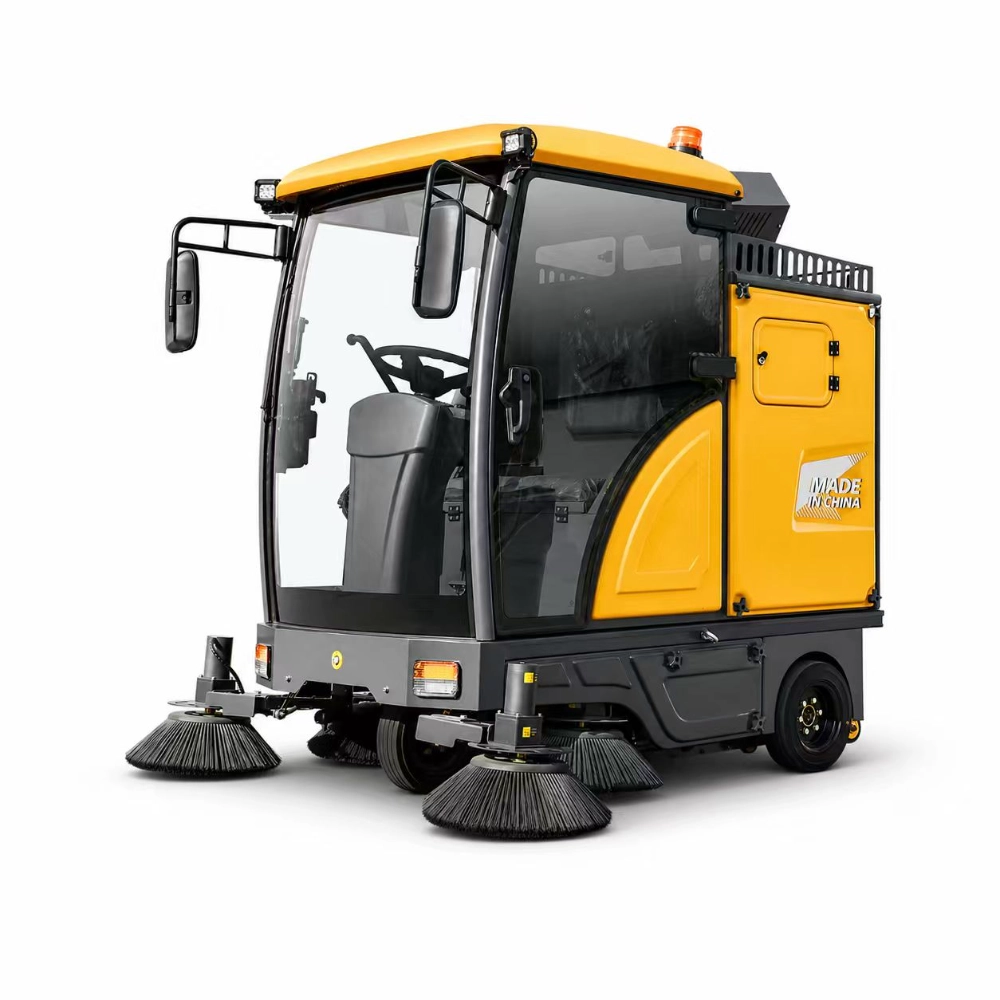
Enclosed Safety Cabins: Forcing operators to ride in the open air amid swirling dust or freezing warehouse temperatures is a massive liability. An enclosed cabin acts as a protective shield, drastically improving operator focus and eliminating weather-related downtime.
Aggressive Traction and Climbing: Subterranean parking ramps and loading docks require serious torque. Your sweeper must be equipped with deeply treaded, anti-slip tires mated to a high-output drive motor, allowing the juggernaut to conquer 30% inclines without hesitation.
Manual Sweeping vs Ride-On Sweeper Comparison
To clearly visualize the operational impact and justify the capital expenditure, let’s contrast traditional manual janitorial labor against a purpose-built high efficiency floor cleaning machine.
| Operational Metric | Traditional Manual Sweeping Crew | Advanced ZY-X2 Industrial Sweeper |
| Hourly Efficiency Rate | ~1,500 m²/h per worker | Up to 20,000 m²/h |
| Airborne Dust Control | Poor (Causes secondary pollution) | Exceptional (10m integrated mist cannon) |
| Labor Headcount Required | 6 to 8 full-time workers | 1 Single Operator |
| Deep Cleaning Capability | Requires separate mop/scrub team | Built-in 1500W high-pressure wash |
| Long-Term ROI & TCO | Negative (Constantly rising wage costs) | Highly Positive (Breakeven often under 6 months) |
Driving ROI in Heavy Manufacturing Operations
Procuring a top-tier commercial floor sweeper is not a sunk cost; it is a strategic capital maneuver. By eliminating the massive, recurring payroll of a manual sweeping team, your return on investment accelerates rapidly. The right equipment transforms a chaotic, dust-choked factory into a pristine, highly efficient production fortress. Never compromise on structural integrity or dust suppression capabilities—invest in machinery engineered to work as relentlessly as your own heavy production lines.
If you need a high-performance heavy-duty industrial sweeper for warehouse, manufacturing, or logistics sites, ZoyonCleaner provides durable, dust-free, cost-effective solutions to boost your ROI.
Frequently Asked Questions
Q: How long do the batteries typically last on a single charge in a factory setting?
For heavy-duty industrial models equipped with a standard 48V 200A battery pack, operators can expect 4 to 6 hours of continuous, high-draw operation. This endurance is carefully engineered to allow a single operator to deep-clean an 80,000 to 100,000 square meter facility within a single shift before a recharge is necessary.
Q: Can these commercial sweepers handle wet sludge or industrial oil spills?
Yes, high-end enclosed models are purpose-built for diverse industrial hazards. Beyond standard sweeping, they feature independent high-pressure washing systems (often pushing 1500W) that allow operators to stop and aggressively blast away stubborn wet sludge, tire marks, and heavy oil stains directly from the cabin.
Q: Is specialized heavy-machinery training required to operate these enclosed units?
No. Despite their imposing, armored appearance, modern enclosed sweepers are engineered with highly intuitive, automotive-style dashboards. A standard warehouse employee can master the steering dynamics, vacuum engagement, and misting controls within just a few hours of basic site orientation