
How to Choose and Use Floor Scrubber Disc Brushes
Release time: 2026-09-10
Table of Contents
A practical guide to brush types, floor compatibility, installation, daily care and replacement
A floor scrubber can only clean as effectively as the brush fitted underneath it. The correct disc brush improves soil removal, maintains stable contact with the floor and reduces unnecessary wear. The wrong material or an incorrect drive coupling can leave dirt behind, cause vibration or damage a sensitive surface.
This guide explains how to select, install, operate and maintain a floor scrubber disc brush for commercial and industrial cleaning. It also shows which measurements and photos a supplier needs to confirm an exact replacement.
What Is a Floor Scrubber Disc Brush
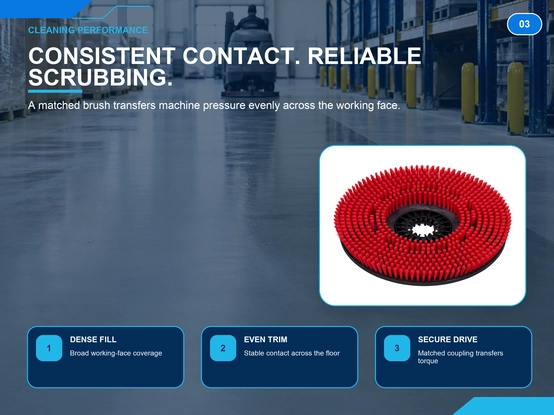
A disc brush is a round brush mounted beneath an automatic scrubber. The machine applies water or cleaning solution while the brush rotates against the floor. Zoyon floor scrubber disc brushes are available in nylon, abrasive grit and wire bristle configurations, with matched backing plates and drive couplings for different machines.
A disc brush is not the same as a pad driver. A disc brush cleans with its own bristles. A pad driver holds a separate floor pad, allowing the operator to change pad grades for scrubbing, stripping or polishing. If your process uses removable pads, see Zoyon floor scrubber pad drivers instead.
View floor scrubber pad drivers
Choose the Brush Material Before Choosing the Color
Brush color can help identify a product within one supplier’s range, but color is not a universal industry standard. Select the brush from the bristle material, floor finish, soil type and machine specifications. When uncertainty remains, test the least aggressive option on a small hidden area.
| Brush type | Best suited to | Main advantage | Important limitation |
| Nylon | Routine cleaning on many sealed hard floors | Flexible contact and good wear life | May not remove heavy buildup quickly |
| Abrasive grit | Deep scrubbing on durable, textured or heavily soiled floors | Stronger mechanical cutting action | Can dull or scratch delicate and polished surfaces |
| Wire | Specialized industrial cleaning and floor preparation on suitable surfaces | Very aggressive action against deposits or coatings | Not suitable for most finished, coated, stone or decorative floors |
| Custom OEM | Dealer fleets and non-standard machines | Material, diameter, density, coupling and packaging can be matched | A sample or complete dimensions may be required |
Nylon Brushes for Routine Cleaning
Nylon is the starting point for many daily cleaning programs. Its flexible bristles can maintain consistent floor contact and are commonly used in supermarkets, offices, schools, hospitals and other facilities with sealed hard floors. It is usually the safer first choice when the floor finish is more important than maximum cutting action.
Abrasive Grit Brushes for Deep Scrubbing
Abrasive grit brushes contain abrasive material in the filament and provide more aggressive soil removal. They are useful for rough concrete, textured industrial floors and built-up dirt that a standard nylon brush cannot remove efficiently. Because aggressiveness varies with grit, filament design, brush pressure and machine speed, always confirm the exact specification and test the surface first.
Wire Brushes for Specialized Work
Wire brushes are intended for demanding industrial applications and some floor-preparation work. They should be treated as a specialized tool rather than a general-purpose cleaning brush. Do not use a wire brush on marble, polished tile, vinyl, sealed wood, decorative floors or coated surfaces unless the floor manufacturer and cleaning process specifically permit it.
Match the Brush to the Floor and Soil
| Floor or condition | Recommended starting point | Use with caution or avoid |
| Epoxy-coated floor | Soft or standard nylon after a test patch | Aggressive grit and wire may damage or dull the coating |
| Polished tile or marble | Soft nylon or a suitable pad system | Wire and aggressive grit |
| Sealed concrete | Nylon for routine work; suitable grit for deep cleaning | Confirm sealer compatibility before aggressive scrubbing |
| Rough uncoated concrete | Nylon or abrasive grit according to soil load | Wire only for a confirmed industrial process |
| Textured safety floor | A brush that reaches into the texture; test nylon first | A flat pad may bridge over recesses |
| Heavy grease or oil | Appropriate brush plus a compatible low-foam detergent | Do not rely on brush aggression alone |
| Coating removal or preparation | Purpose-selected grit or wire after surface approval | Never begin on an unknown finish |
The floor material is only part of the decision. Cleaning frequency, brush pressure, rotation speed, water flow, detergent chemistry and operator speed all affect the result. Start with the least aggressive combination that can complete the task, then increase cleaning action gradually if needed.
How to Confirm the Correct Replacement Brush
Brand name alone is not enough to guarantee fit. Machines from the same brand may use different diameters, backing plates and coupling patterns. Confirm all of the following before ordering:
- Machine brand and exact model number;
- Required quantity and whether the machine uses one or two disc brushes;
- Hard plastic backing plate diameter measured edge to edge, excluding the bristles;
- Clear, straight-on photo of the drive coupling;
- Full photos of both the working side and drive side of the original brush;
- Floor material, main soil type and cleaning objective;
- Any OEM label, color or packaging requirement.
For an unfamiliar machine, keep the original brush until the replacement is confirmed. Coupling shape, mounting height and plate diameter must match; a brush that appears similar may not transfer torque correctly or may interfere with the scrub deck.
How to Install a Disc Brush Safely
Use the machine manufacturer’s manual as the final authority because mounting methods differ. The following procedure is a general checklist:
- Park the machine on a level surface, switch it off, remove the key where applicable and disconnect charging power.
- Raise or secure the scrub deck according to the machine instructions.
- Inspect the backing plate, drive coupling and mounting area. Remove string, wire, film and hardened debris.
- Check that brush diameter, coupling, rotation direction and deck clearance match the machine.
- Align the brush with the drive hub and lock it using the method specified for that model.
- Lower the deck and briefly test the machine in a clear area. Stop immediately if the brush wobbles, strikes the deck or creates abnormal noise.
Operating Practices That Improve Brush Life
Pre-sweep loose debris. Metal fragments, cable ties, packaging film and stones can damage the brush, block the squeegee or become entangled in the drive.
Use the correct detergent. Choose a low-foam product compatible with the floor and machine. Excess foam can reduce water recovery and may reach the vacuum system.
Begin with moderate settings. Excessive brush pressure does not always improve cleaning. It can increase current draw, shorten brush life and overload the drive system.
Allow chemical dwell time. For stubborn soil, apply the approved solution and allow controlled dwell time without letting it dry. A double-scrub process may work better than extreme brush pressure.
Maintain a steady travel speed. Moving too quickly reduces contact time; moving too slowly may overwork one area. Use overlapping passes where necessary.
Test sensitive floors. Complete a small trial in an inconspicuous area whenever the floor finish, detergent or brush specification changes.
Daily Cleaning and Storage
After each shift, switch off and secure the machine before removing the brush. Rinse away detergent and embedded soil with clean water. Remove fibers, plastic film and other wrapped debris by hand while wearing suitable gloves. Inspect the backing plate and coupling for cracks or distortion, then allow the brush to dry fully in a ventilated area.
Store brushes clean and dry, protected from direct sunlight, high heat and chemicals. Do not stack heavy objects on the bristles or leave a loaded scrub deck resting on one spot for long periods, as this can deform the filament and cause uneven contact.
When Should a Disc Brush Be Replaced
There is no single replacement interval for every facility. Brush life depends on floor roughness, pressure, operating hours, chemical exposure and cleaning practice. Replace or investigate the brush when you notice:
- Bristles have become noticeably shorter, uneven, bent or permanently flattened;
- Cleaning performance has declined even after the brush and solution system are cleaned;
- The machine vibrates or the brush no longer runs evenly;
- The backing plate is cracked, warped or contacting the scrub deck;
- The coupling is damaged, loose or no longer locks securely;
- Filament or wire is shedding abnormally.
Do not wait for complete failure. A damaged coupling or backing plate can affect the machine drive assembly and create additional repair costs.
Common Problems and Corrective Checks
| Problem | Likely cause | What to check |
| Poor soil removal | Brush too soft, worn bristles, insufficient dwell time or incorrect detergent | Clean and inspect the brush; verify chemical dilution; test the next suitable brush grade |
| Circular marks or dulling | Brush too aggressive, excessive pressure or abrasive debris trapped in bristles | Stop work, inspect the floor and brush, reduce pressure and test a softer option |
| Vibration or jumping | Wrong coupling, warped plate, uneven wear or trapped debris | Switch off immediately; inspect fit, deck clearance and brush condition |
| Brush does not lock | Incorrect interface, damaged hub or debris in the coupling | Compare the original coupling and exact machine model; do not force installation |
| Uneven cleaning path | Uneven bristle wear, deck alignment issue or inconsistent solution flow | Inspect brush face, deck mechanism and water distribution |
| Short brush life | Too much down pressure, rough floor, dry operation or wrong material | Review settings and application; select a more suitable filament |
Disc Brush or Pad Driver Which Should You Use
| Choose a disc brush when | Choose a pad driver when |
| The floor is textured or has grout lines that bristles need to reach | The task requires interchangeable pads for cleaning, stripping or polishing |
| The site needs a durable daily-cleaning tool with no separate pad | The floor is smooth and the required pad grade is already specified |
| Loose fibers or uneven surfaces make stable brush contact useful | Fast changes between pad applications are important |
Both options depend on an exact machine fit. Browse the complete floor cleaning machine parts and accessories range to compare disc brushes, pad drivers, squeegee blades and hose assemblies.
Information to Send When Requesting a Quote
A complete inquiry reduces the risk of ordering the wrong brush and shortens confirmation time. Send the machine brand and exact model, plate diameter, coupling photos, brush photos, floor and soil details, quantity, destination country and any private-label requirements.
Zoyon supplies replacement disc brushes for multiple commercial scrubber brands and can customize bristle material, diameter, density, color, drive interface and packaging. Contact Zoyon Cleaner for model verification and a current quotation, or browse our floor cleaning machines if you are selecting a complete scrubber system.
Frequently Asked Questions
Can I identify a floor scrubber brush by color alone?
No. Colors may differ between manufacturers. Confirm the bristle material, aggressiveness, diameter, coupling and intended floor application.
Should I measure the full brush including the bristles?
For replacement matching, measure the hard plastic backing plate edge to edge unless the supplier specifically asks for another dimension. Also provide a clear coupling photo.
Can a wire brush be used on an epoxy floor?
Generally it should not be the first choice. Wire can damage or remove coatings. Confirm the floor specification and test an approved, less aggressive brush first.
Why does the machine vibrate after installing a new brush?
Possible causes include an incorrect coupling, incomplete locking, trapped debris, a warped backing plate, wrong diameter or interference with the deck. Stop the machine and inspect the installation.
How often should the brush be cleaned?
Rinse and inspect it after each working shift. Allow it to dry fully before storage.
Can one brush be used for every floor in a facility?
Not always. A brush suitable for rough concrete may be too aggressive for polished stone or coated floors. Separate and label brushes when different areas require different cleaning actions.
Conclusion
The best floor scrubber disc brush is not simply the hardest or most aggressive option. It is the brush that matches the floor finish, soil level, machine pressure and drive interface while delivering the required result without avoidable surface or equipment wear. Confirm the fit carefully, test the least aggressive suitable material and clean the brush after every shift.