
Warehouse Floor Cleaning: Should You Choose a Sweeper, Floor Scrubber, or Scrubber Sweeper?
Release time: 2026-07-22
Keeping a warehouse floor clean is not only about appearance. Dust, packaging scraps, pallet debris, tire marks, oil stains and spilled liquids can affect workplace safety, product quality and daily operating efficiency.
Different warehouse floor problems require different cleaning equipment. A ride-on sweeper, a floor scrubber and a scrubber sweeper perform different tasks. Choosing the wrong machine may increase cleaning time, labor costs and equipment maintenance. This guide explains their differences and helps warehouse managers choose the right solution.

What Is the Main Cleaning Problem in Your Warehouse?
Before comparing specifications, identify the type of contamination that appears most frequently:
- Dry debris: dust, sand, leaves, paper scraps, plastic film, pallet fragments and packaging waste.
- Adhered dirt: tire marks, footprints, oil residue, grease and dried stains.
- Mixed contamination: loose debris and floor stains appearing in the same working area.
The right machine depends primarily on the material being removed—not simply the size of the warehouse.
1. Choose a Ride-On Sweeper for Dust and Solid Debris
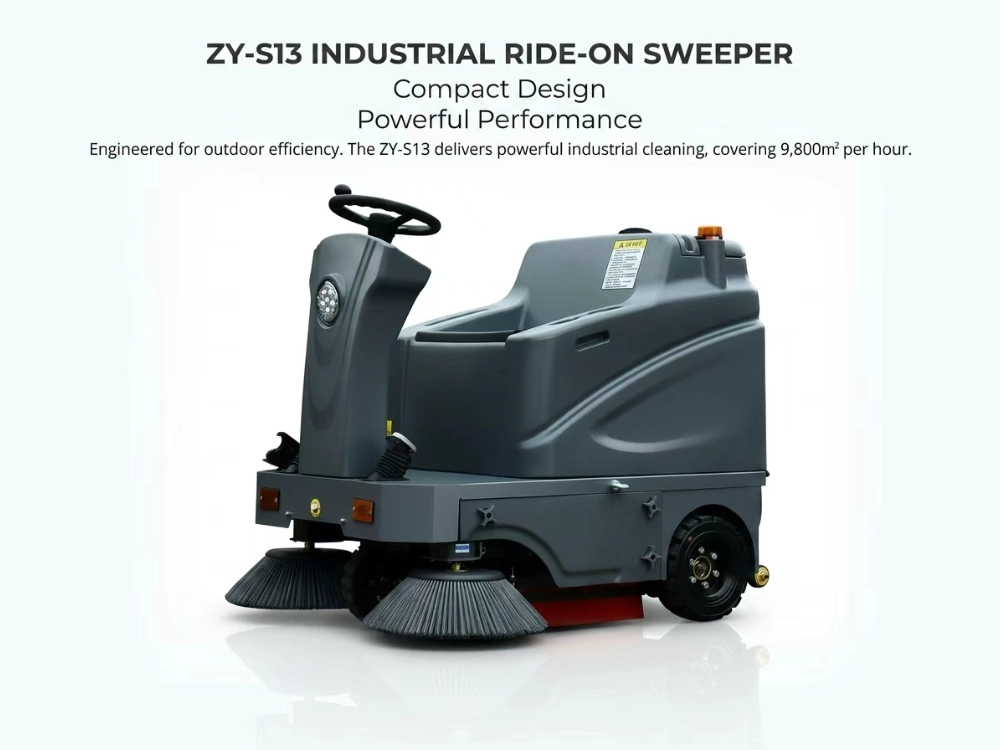
A ride-on sweeper uses side brushes to collect debris toward the main brush, transfers it into a waste container, and uses vacuum and filtration systems to help control airborne dust.
- Warehouses with frequent pallet or packaging debris
- Logistics yards and loading areas
- Factories producing dust, sand or small solid particles
- Indoor and outdoor areas requiring regular dry sweeping
- Large sites where manual brooms are too slow
For large industrial areas, the ZY-X3 Ride-On Floor Sweeper offers a 2,300 mm sweeping width and rated working efficiency of 16,000 m²/h. Its large waste container, dust-suppression system and enclosed cabin suit warehouses, factories, logistics yards and outdoor industrial areas.
A sweeper collects loose material effectively, but it does not wash away oil, tire marks or adhered stains. If these are the main problems, a scrubber is usually more appropriate.
2. Choose a Floor Scrubber for Stains and Wet Cleaning
A floor scrubber applies cleaning solution, uses rotating brushes to loosen dirt, and collects dirty water through a rear squeegee and vacuum system.
- Epoxy, concrete, terrazzo, tile and other hard floors
- Warehouses with tire marks or forklift traffic
- Food, manufacturing and packaging facilities
- Oil residue, footprints and adhered dirt
- Areas needing a clean and nearly dry floor after each pass
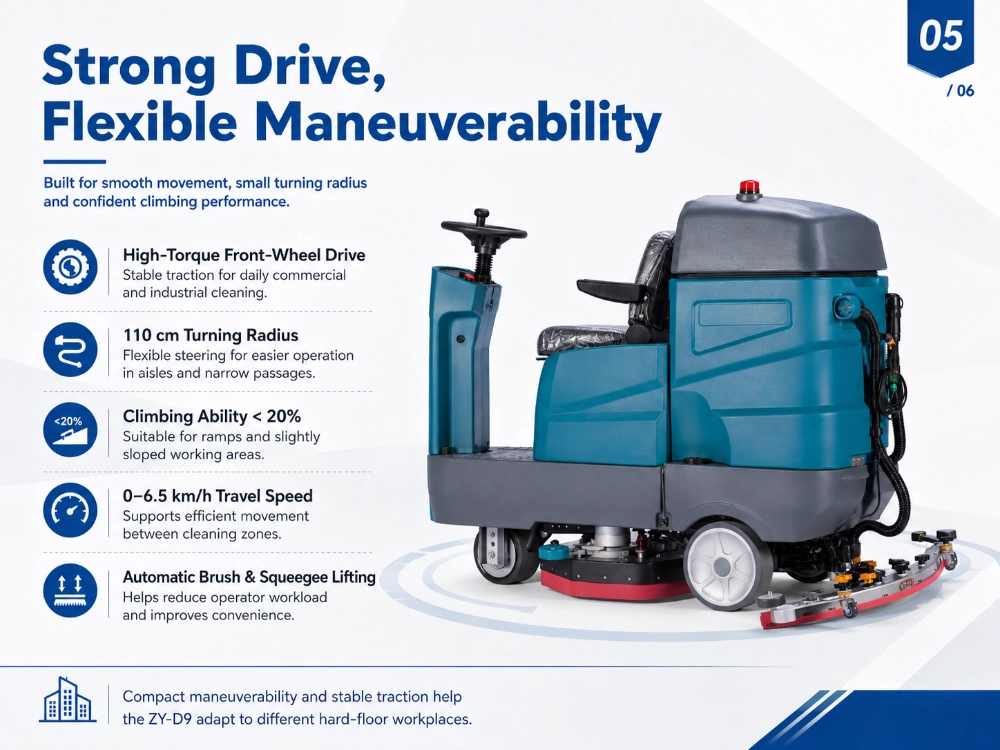
For large-area hard-floor maintenance, the ZY-D9 Ride-On Floor Scrubber provides a 910 mm cleaning width, 160 L solution tank, 180 L recovery tank and rated efficiency of up to 6,000 m²/h.
ZY-D9 is a dedicated large ride-on scrubber for intensive wet scrubbing and dirty-water recovery. It is suitable when a warehouse has limited large debris but regularly develops stains, tire marks or oil residue. Packaging material, wood fragments and other larger debris should normally be swept first to protect the brushes and squeegee and improve results.
3. Choose a Scrubber Sweeper for Mixed Debris and Floor Stains
Some warehouses have dry debris and stubborn contamination in the same aisle. In this situation, an integrated scrubber sweeper can reduce the need to use two separate machines.
The ZY-D8G Ride-On Floor Scrubber Sweeper combines sweeping, scrubbing and dirty-water recovery. Its dual roller-brush system can collect suitable small debris while washing the hard floor.
- Warehouses with recurring mixed contamination
- Manufacturing facilities generating small debris and stains
- Sites seeking to reduce separate sweeping and scrubbing passes
- Large hard-floor areas with suitable aisle width
- Cleaning teams that want a simpler daily process
ZY-D8G and ZY-D9 are not two versions of the same machine. ZY-D8G is an integrated sweeping-and-scrubbing machine, while ZY-D9 is a large-capacity dedicated scrubber. The key question is whether loose debris must also be collected during cleaning.
Sweeper vs Floor Scrubber vs Scrubber Sweeper
| Comparison | Ride-On Sweeper | Ride-On Floor Scrubber | Scrubber Sweeper |
| Main function | Collects dry dust and solid debris | Scrubs stains and recovers dirty water | Sweeps, scrubs and recovers water |
| Best for | Sand, dust, leaves, paper and packaging waste | Tire marks, footprints, oil and adhered dirt | Mixed light debris and floor stains |
| Cleaning water | Normally no; water may be used for dust suppression | Yes | Yes |
| Loose debris | Strong collection ability | Limited; pre-sweeping usually required | Collects suitable small debris |
| Stubborn stains | No | Yes | Yes |
| Typical use | Loading areas, logistics yards and dusty warehouses | Indoor hard floors and forklift aisles | Warehouses with recurring mixed contamination |
| Zoyon model | ZY-X3 | ZY-D9 | ZY-D8G |
Is One Combined Machine Always Better Than Two Separate Machines?
Not necessarily. A scrubber sweeper can save time when suitable small debris and stains frequently appear together. Two dedicated machines may still be more effective when:
- The warehouse produces large quantities of dry debris
- Outdoor sweeping and indoor scrubbing are separate tasks
- Large or sharp waste could damage the scrubbing system
- Sweeping and scrubbing must be performed at different times
- Different operators clean different areas simultaneously
For example, a large sweeper can clean outdoor loading yards and collect packaging waste, while a dedicated scrubber handles indoor epoxy floors and forklift marks. Base the decision on the complete cleaning process, not simply the number of functions listed on the machine.
How Does Warehouse Size Affect Machine Selection?
Floor area matters, but usable cleaning space matters more than total building area. Evaluate:
- Net cleanable floor area
- Width of the narrowest aisle
- Shelves, pillars and loading zones
- Turning space at aisle ends
- Slopes and ramps
- Available cleaning time per shift
- Distance to the charging station
A machine may not achieve its rated efficiency in narrow aisles with frequent turns and heavy traffic. Large ride-on machines suit open logistics centers and factories; compact ride-on or walk-behind scrubbers may be more practical where shelves restrict turning space.
What Floor Conditions Should Be Checked?
Floor material
Scrubbers are commonly used on epoxy, cement, concrete, terrazzo, marble and tile. Match the brush or pad to the surface.
Floor unevenness
Large gaps, broken surfaces or raised edges can affect brush contact and water recovery.
Debris size
Small dust and fragments may be handled by a scrubber sweeper. Large wood pieces, metal parts, straps or plastic film should be removed separately.
Oil and grease
Industrial oil may require a suitable detergent, brush material and repeated cleaning.
Ramps
Check gradeability and braking requirements when the warehouse includes ramps or loading platforms.
Battery Capacity and Working Time
Battery capacity should be selected according to the actual cleaning shift, not only warehouse size. Consider continuous operating time, charging time, shifts per day, cleaning intensity, power used by vacuum motors and brushes, and the charging area. Where longer operation is required, battery capacity may be configured according to machine compatibility and the cleaning requirement. Discuss expected daily working hours with the manufacturer before confirming the configuration.
A Simple Selection Guide
Choose a ride-on sweeper if:
- Most contamination is dry and loose.
- Packaging waste, sand or dust is the main problem.
- Indoor and outdoor sweeping is required.
- Wet scrubbing is not the primary task.
Choose a ride-on floor scrubber if:
- The warehouse has tire marks, footprints or oil residue.
- Most loose debris has already been removed.
- A washed and nearly dry floor is required.
- Hard-floor maintenance is the priority.
Choose a scrubber sweeper if:
- Light debris and stains frequently appear together.
- Separate sweeping and scrubbing take too much time.
- The floor is suitable for wet cleaning.
- Most debris fits the integrated collection system.
Frequently Asked Questions
Can a floor scrubber replace a sweeper?
A scrubber can collect limited fine dirt, but it is not designed for large quantities of packaging scraps, wood fragments or solid waste. Pre-sweeping is recommended when loose debris is present.
Can a ride-on sweeper remove oil stains?
No. It collects loose dry material but does not scrub adhered oil or tire marks. A floor scrubber is required.
Is a scrubber sweeper suitable for every warehouse?
No. It works best when suitable light debris and stains occur together on hard floors. Large or sharp waste may still require a dedicated sweeper.
Which machine is best for a large logistics warehouse?
Choose a large ride-on sweeper for mainly dry debris, a ride-on scrubber for mainly tire marks and stains, or a scrubber sweeper when both problems repeatedly occur in the same area.
Conclusion
There is no single cleaning machine that is best for every warehouse. A ride-on sweeper is designed for dust and solid debris; a floor scrubber is designed for wet cleaning and stain removal; and a scrubber sweeper combines both processes when mixed contamination is the main challenge.
Before choosing a machine, evaluate debris type, floor material, aisle width, cleaning area, required working time and the daily cleaning process. Anhui Zoyon Clean Tech Co., Ltd. provides ride-on sweepers, floor scrubbers and integrated cleaning equipment for warehouses, factories, logistics centers and commercial facilities. Share your floor area, aisle width, floor type and main cleaning problem with us, and we can help identify a suitable configuration.